Hendrickson Lifesaver Card White Single
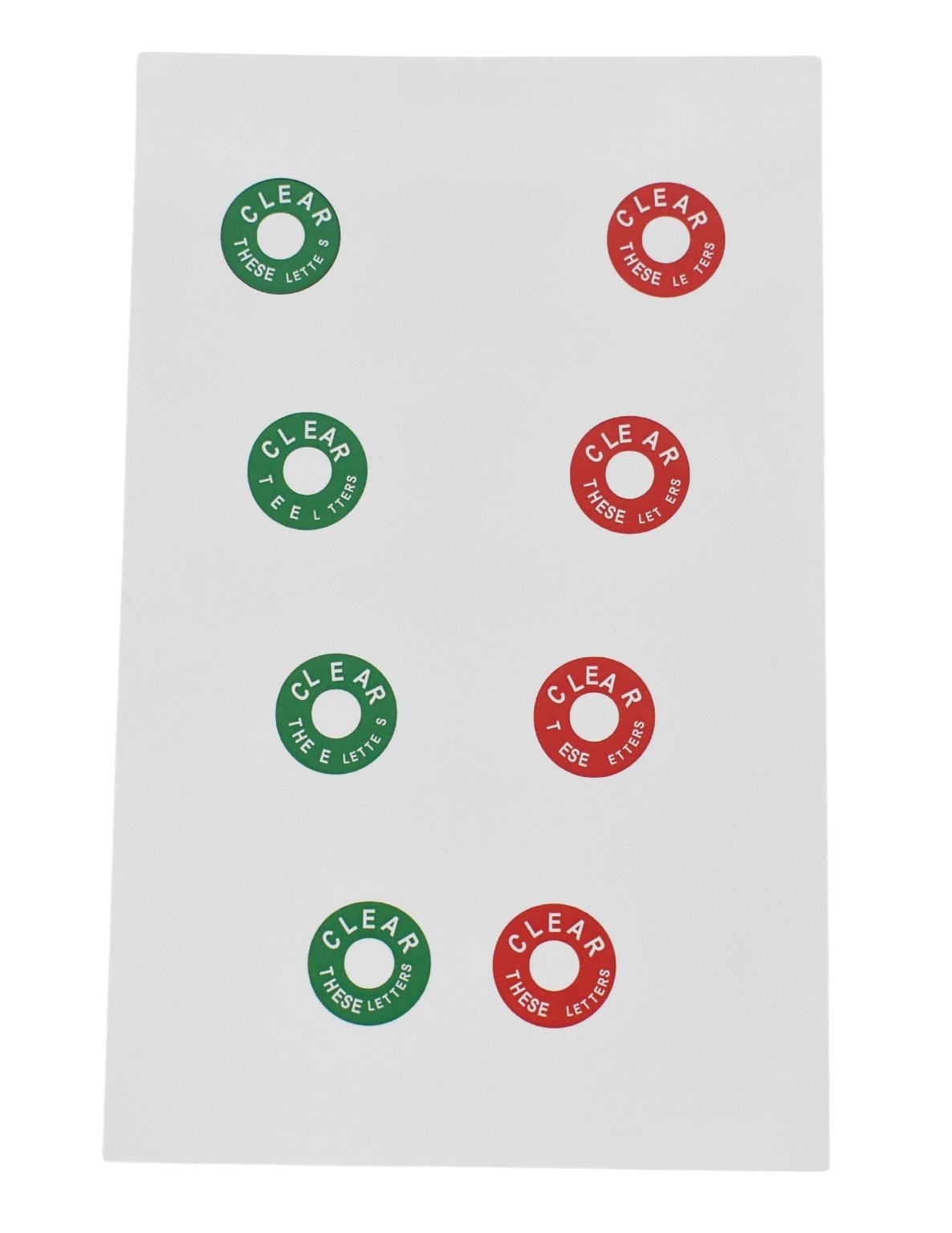
The Hendrickson Life Saver Cards – White are opaque free-fusion targets with high-contrast “lifesaver” rings that train vergence (convergence/divergence), stereo awareness, and anti-suppression—all without special glasses. The solid white backing boosts visibility and reduces background distractions, making fusion easier for beginners while you vary spacing/orientation to build range and facility.
Product Code: JVHLW
What it develops: Convergence/divergence range, vergence facility, stereo stability, and suppression control
Why white backing helps: Higher contrast and fewer distractions make fusion easier for newcomers and low-contrast environments
How to use (quick start): Hold at ~40 cm; align the two lifesaver rings; fuse into one “popping” donut; vary spacing—overlap (BO) or separate (BI)—to change demand
Progressions: Begin close/easy → increase spacing or add timed reps/metronome → introduce small rotations for gentle cyclofusion
Feedback cues: Stable single donut with depth = success; color/edge “drop-out,” ghosting, or double images signal suppression or loss of fusion—reduce demand and rebuild
Who it suits: Children through adults; ideal for clinic blocks and home VT with clinician guidance
Great pairings: Brock string, dot/barrel convergence cards, eccentric circles, fixation sticks for precise targets
Good practices: Keep posture steady, blink normally, breathe; log reps, time, break/recovery distances to track gains
Care: Wipe with a soft, non-abrasive cloth; avoid solvents/heat; store flat to preserve contrast and alignment
| Sr No | Topic | Description |
|---|---|---|
| 1 | Category | Vision Therapy / Binocular Vision Training Tool |
| 2 | Purpose | The Hendrickson Lifesaver Card – White is a vision therapy tool designed to train divergence (base-in vergence) and reduce excessive convergence demand. It helps patients develop the ability to relax convergence and maintain binocular fusion by viewing background targets through the card’s circular openings. |
| 3 | Target Users | Intended for optometrists, orthoptists, vision therapists, and patients undergoing binocular vision therapy. It is commonly prescribed for individuals with convergence excess, binocular stress during near work, or general vergence imbalance. The card can also be used in supervised home vision therapy programs. |
| 4 | Optotypes / Symbols | The card itself does not contain letters or standard optotypes. Instead, it features circular “lifesaver” cutouts that allow the patient to view a background target (such as a letter chart or fixation target). The background stimulus becomes the visual target while the card guides binocular alignment. |
| 5 | Scaling / Spacing | The card contains fixed circular openings positioned at specific intervals. These openings help guide the eyes to align and maintain divergence while viewing the background stimulus. The design is static, and vergence demand is controlled by patient positioning and fusion of the background targets. |
| 6 | Physical Size & Dimensions | The card is typically manufactured in a compact rectangular format approximately 6.5 × 4.5 inches, making it easy to handle during therapy sessions. The size provides sufficient viewing area for the circular openings and background fixation targets. |
| 7 | Mounting / Display | The card is designed for handheld or overlay use. It is placed between the patient and a background stimulus such as a letter chart, fixation target, or reading material. It is not designed for wall mounting. |
| 8 | Features | Key features include circular “lifesaver” cutouts, an opaque white surface for strong visual contrast, and a simple design that encourages binocular divergence and peripheral fusion. The openings guide the eyes to relax convergence while maintaining single binocular vision. |
| 9 | Included Accessories | The product typically includes the Hendrickson Lifesaver Card (white) and may be supplied with basic usage instructions for vision therapy exercises. Additional accessories such as charts or therapy guides may be provided separately. |
| 10 | Durability / Material Qualities | The card is usually made from durable white plastic or laminated card material, providing resistance to bending, moisture, and repeated clinical handling. The rigid structure helps maintain precise shape and alignment of the circular openings during therapy use. |
| 11 | Usability / Marker of Quality | The Hendrickson Lifesaver Card is widely used in vision therapy programs for vergence training. High-quality versions feature cleanly cut circular openings, durable material construction, and consistent spacing, ensuring reliable binocular training. Its simple overlay design makes it easy to use in both clinical and home therapy environments. |
Related products
-
Flipper, Vision Therapy
Confirmation Flipper -/+2.00D
The Confirmation Flipper ±2.00 D is a near-vision lens flipper for training and verifying accommodative facility, challenging patients to switch focus quickly and accurately at a slightly higher demand than ±1.50. It’s ideal for timed near tasks (letters/words) to record cycles per minute (CPM) and track improvements in clinic or supervised home programs.
Product Code: JVCF Flipper
SKU: JVCF2.00 -
Vision Therapy
Brock String with 5 Beads – 10ft
The Brock String is a simple string with colored beads used to train convergence, eye-teaming, and anti-suppression—patients learn to keep a single bead clear while seeing a correct “X” pattern of the string. It’s a fast, repeatable drill for clinic or home programs to build vergence range, recovery, and stability at different working distances.
Product Code: JVBS510
SKU: JVBS510